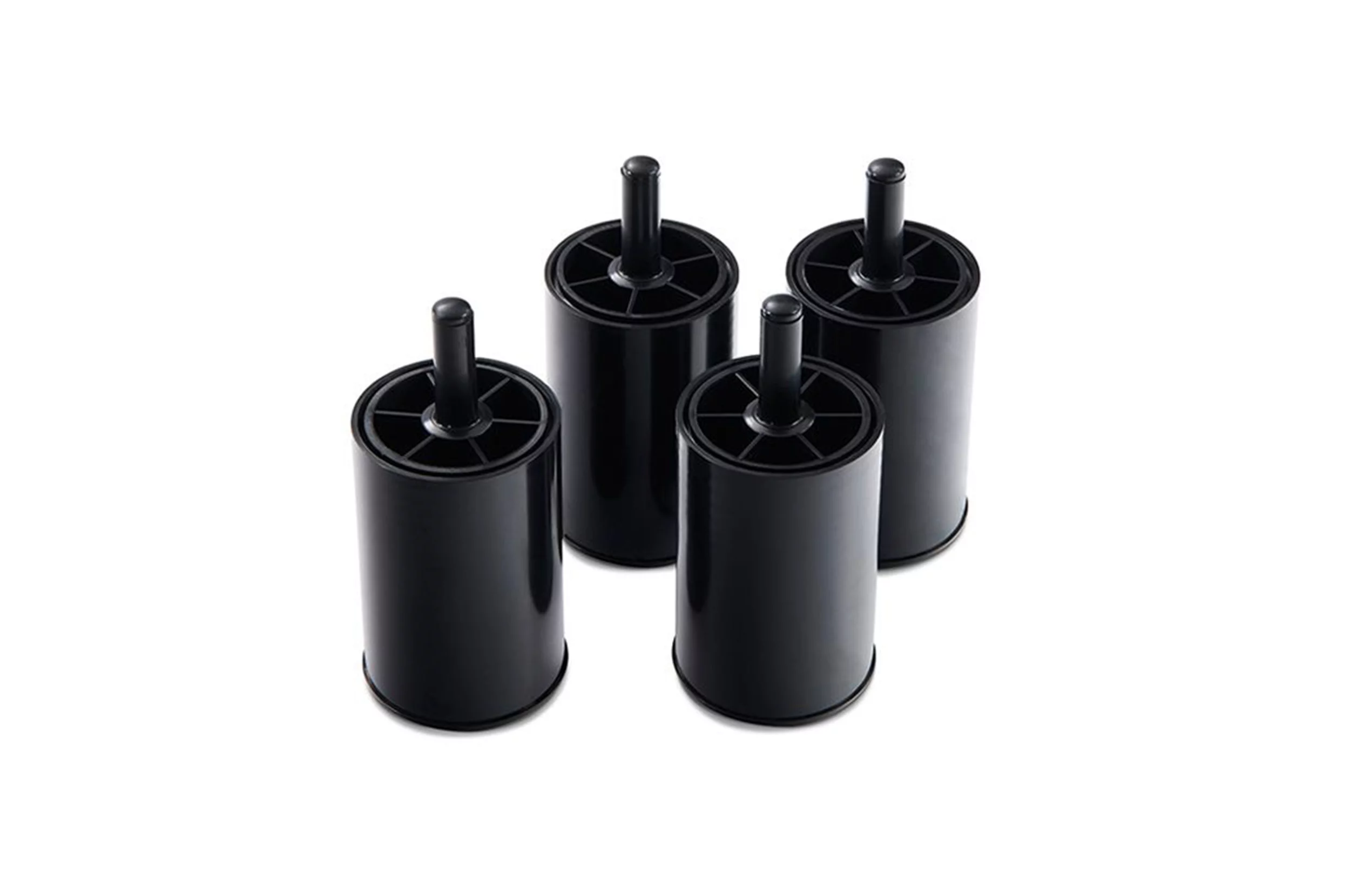
As I was in Sydney, I went back to the same store I had ordered from 17 years ago. Two helpful staff took me through the intricacies of which spare parts fitted which model sofa, which height legs I needed (adjustable or fixed, what finish). I handed over $50 and left with four legs and two brackets to turn the sofa into a bed. The legs and brackets simply push into sockets on the chairs. King's modular furniture is not cheap, but as I can attest, is durable and flexible.
Showing posts with label furniture design. Show all posts
Sunday, April 27, 2025
Sofa Upgrade Seventeen Years On
Seventeen years ago, I purchased a Delta modular sofa from King Furniture in Annandale, Sydney. Recently I found a module for this system at Vinnies. It needed cleaning, but the biggest problem was no legs. So I looked online and found that while the Delta has gone through several upgrades, parts were still available.
Tuesday, September 03, 2013
Fred Ward: Australian pioneer designer 1900-1990
The new book "Fred Ward: Australian pioneer designer 1900-1990" by Derek F. Wrigley celebrates the work of someone who has shaped the built environment for much of my working life without my knowing it. This book is more than a biography, going into detail of the elements and philosophy of furniture design. Included is a detailed case study of the iterative design process used for the CA10 chair for the John Curtin School of Medical Research (c1956).
In February 2012 I was asked to provide some advice on publishing for Derek Wrigley's biography of Fred Ward. I had never heard of Fred Ward, but agreed to I met Derek a few weeks later to discuss the topic over lunch at University House at the Australian National University. As Derek talked about Fred, it slowly dawned on me that the chair I was sitting on, and all the furniture around me, was designed by Fred Ward. I provided some advice on how to produce the manuscript and was delighted to see, a year and a half later the finished book (with an acknowledgement of me in the back).
It was only on reading Derek's book that I realized for much of my adult life I had been surrounded by Fred Ward's work. Along with the furniture and fittings in the ANU University House, Fred Ward designed the furniture at the National Library of Australia, the Shine Dome (which I attended the 2013 Marion Mahony Griffin Lecture), even the desks and chairs in the Reserve Bank of Australia, where as a junior clerk I used to make deposits.
The fine details of the curvature of the seats in a university office may not be of interest to many academics. But Derek also describes the wider work of the ANU Design Unit, which carried out research on the design of teaching spaces. In particular the discussion of the use of chairs, rather than fixed seating in teaching spaces is a topic of great importance to universities today. For the last few years I have been looking at how to provide more flexible teaching spaces which can be used for combinations of lecturing, tutorials and group work with changed teaching practices. The rigid division between lecture theaters, with large numbers of seats at a fixed pitch, facing the front and small tutorial rooms with movable seats, is not suitable. It was a surprise to find that ANU had a design unit looking into such issues decades ago.
The design of the book itself, by Gillian Cosgrove, is in itself, a lesson in elegant design. The paperback edition is available from the Co-op Bookshop and the Portrait Gallery Store. Hopefully an e-book edition will be available soon for student use.
Tuesday, March 06, 2012
Standing Desks
With some searching on-line I found the term for a desk used when standing is a "stand-up" or standing desk. Amazon.com sell "standing desks".
There is the wonderfully titled article "Become a Stand-Up Guy: The History, Benefits, and Use of Standing Desks" by Brett & Kate McKay on July 5, 2011. The company Standup Desks. offers Measuring Tips.
Thursday, February 02, 2012
LED lights for innovative room design
ps: I was actually here for the Pacific 2012 Maritime Defence Conference in the next hall of the conference center.
Sunday, August 01, 2010
Last days of reading a magazine at the library
The National Library of Australia main reading room has six racks for magazines. It has been my pleasure to spend Sunday afternoons in the library reading these. I would start at one end and work my way to the other, with a break to browse the new books on display and for coffee in the Bookplate cafe. However, the number of magazines has been shrinking over the years. The furthest of the six racks now has no magazines and some brochures have been put there to make it look less bare. The other racks are about one third full. I suspect this is a result of the success of online publications, for which I am partly responsible (having helped convert the IT profession to e-publishing in Australia, and Internationally). But while the e-journals are more efficient, there is something lost, in not being able to sit in a comfortable chair and just flip through a publication. Electronic journals can be read at the computers in the reading room. But these are placed on high desks, with high stools (somewhat reminiscent of monks at a scriptorium).
Perhaps the NLA needs to consider the electronic equivalent of the comfy chair, for browsing, with some sort of e-reader equipped low seating. What I have in mind is something like a King furniture Delta modular chair, equipped with a touch screen on an articulated arm (taking advantage of the chair's modular system), to make the upholstered equivalent of an Apple iPad.
Sunday, January 17, 2010
E2 Ethos Shelving System
The E2 Ethos Shelf System is on special at Bunnings Hardware. This is a very elegant system using cast aluminium channels attached to the wall, into which slot cast aluminium brackets. Apart from the screw holes to hold the channels to the wall there are no other holes or protrusions in the channels (unlike most modular shelving systems
). Each cast aluminium bracket is held by a grub screw tightened with the included Allen key. The shelf brackets have a cast curved support framework. The whole effect is reminiscent of an art deco 1930s train carriage luggage rack.
After purchasing their 1100 mm four shelf pack, it quickly became apparent why these are on special. The system of attaching the shelves to the channels requires close tolerances in the manufacture to allow the brackets to slide up and down for adjustment, but be sufficiently tight so they can be locked in place. Unfortunately half the brackets did not fit in the channel as they were not correctly cast had excessive metal. This required a laborious process of filing down each bracket until it fitted. Also the screw holes for holding the channel to the wall are not sufficiently recessed (a design flaw) so if the screws are not precisely aligned they stop the brackets from sliding past.
After a few hours of filing and of unscrewing and re-screwing, the results look good in a 1930s inner Sydney art deco style kitchen. But it would have been a lot easier to use one of the much less elegant, but more forgiving, modern steel shelving systems.
The E2 Ethos web site seems to suffer similar problems to their shelving system: it looks elegant but is very difficult to use. The home page provides a menu bar and an animation of shelves moving up and down. The only other content on the page is the number "01908 216466". Placing the mouse over "Storage" in the menu displayed a list of items. I couldn't read the items as the text was overlapping. Clicking on the menu items produced no apparent result.
Normally with a poorly designed web page I select "View > Page Style > No Style" so I can see a version of the page without the faulty formatting. In this case that did not work. I could try displaying the source code of the page and try to work out what was going on, but this would be a laborious process, like fining bits off the shelf brackets. As it is the web page provided me with no useful information, apart from confirming the company made shelves which can be adjusted up and down.
After purchasing their 1100 mm four shelf pack, it quickly became apparent why these are on special. The system of attaching the shelves to the channels requires close tolerances in the manufacture to allow the brackets to slide up and down for adjustment, but be sufficiently tight so they can be locked in place. Unfortunately half the brackets did not fit in the channel as they were not correctly cast had excessive metal. This required a laborious process of filing down each bracket until it fitted. Also the screw holes for holding the channel to the wall are not sufficiently recessed (a design flaw) so if the screws are not precisely aligned they stop the brackets from sliding past.
After a few hours of filing and of unscrewing and re-screwing, the results look good in a 1930s inner Sydney art deco style kitchen. But it would have been a lot easier to use one of the much less elegant, but more forgiving, modern steel shelving systems.
The E2 Ethos web site seems to suffer similar problems to their shelving system: it looks elegant but is very difficult to use. The home page provides a menu bar and an animation of shelves moving up and down. The only other content on the page is the number "01908 216466". Placing the mouse over "Storage" in the menu displayed a list of items. I couldn't read the items as the text was overlapping. Clicking on the menu items produced no apparent result.
Normally with a poorly designed web page I select "View > Page Style > No Style" so I can see a version of the page without the faulty formatting. In this case that did not work. I could try displaying the source code of the page and try to work out what was going on, but this would be a laborious process, like fining bits off the shelf brackets. As it is the web page provided me with no useful information, apart from confirming the company made shelves which can be adjusted up and down.
Tuesday, December 01, 2009
Origami classroom furniture
Thursday, October 29, 2009
E-documents can make government offices smaller
Media reports indicate that the Finance Minister, Lindsay Tanner has said that new federal government offices will be reduced from around 25 square metres per person to 16 square metres. In January I suggested that as most paper is replaced with computer storage in new offices and the computer storage is located off site, the size of offices should be able to be reduced down to 8 m2 per person. The m2 allocation for Australian Government offices therefore look generous.
The UK Government report "Improving the efficiency of central government's office property" (28 November 2007) proposed 12 m2 per person. It should be noted that this is not the actual space each office worker gets, but is calculated from the Net Internal Area (the area within a building measured to the internal surface of the perimeter walls at each floor level), not just the floor space of individual offices. For comparison, The Pentagon was designed for 11.6 m2 per person.
Wednesday, May 27, 2009
Saving money and energy in the learning commons
The University of Canberra is remodelling one floor of its library into a Learning Commons. Library users were asked for input so I should put in some comments, about the use of furniture, computers and lighting. Here are some more comments about floor space, air conditioning and lights:
- Reduce floor area: A major determinate of cost and environmental impact of a building is size: the bigger the building, the higher the financial and ecological cost. I suggest using a higher density of seating than is usual in learning commons: twice that currently used in the University of Canberra library. This can be done by using compact computers, carefully positioning seating and interspersing desktop and laptop positions. A space allocation of 2 m2 per student could be achieved with careful design. This could halve the cost of facility.
- Separate Air Conditioning: As the learning commons will be open when the rest of the library is closed, a separate air conditioning system should be used, which just conditions that floor. This will save having to heat or cool the whole building, as is done at present. If there are several enclosed rooms, these can be air conditioned separately, so unused rooms are not conditioned.
- Automated lights: Normally libraries leave all lights on when any of the building is open, even when large areas are unused. Lights should shift to a lower power setting when an area is unoccupied and switch back to full power when someone enters. This can be done much more simply with LED lights than with fluorescent lights. It should be noted that lights should not switch off completely in open plan areas for safety reasons. Lights can switch off in closed rooms when they are unoccupied and on again when the door is opened.
Wednesday, May 20, 2009
Designing a Learning Commons
The University of Canberra is remodelling one floor of its library into a Learning Commons. This is to provide more access to computers and facilities for group work. The library users have been asked for input and plans will be on display in June. As a user who has made a study of such learning commons, I thought I should put in some comments:
Some thoughts on a design
- Movable furniture is not necessarily flexible: Many of the designs I have looked at use movable items of furniture, on the assumption this makes the space "flexible". In practice the furniture rarely gets moved, after the initial novelty of being able to move it wares off (apart from when the students get playful and use it for furniture sculpture). Where computers and data access is used having movable furniture become very expensive and creates a large maintenance bill. I suggest instead having fixed, low cost furniture with built in wiring, which and be used in different ways, but without having to be moved. Expensive proprietary cabling systems and modular furniture are not needed: cheap laminate will do. The University of Queensland Ezones have a good arrangement with custom made curved desks with wire baskets under the desks to hold the cabling.
- Mix laptop and desktops: One trend has been to provide separate areas for laptops and desktop computers, with the laptops tending to get less space. Instead I suggest mixing the two. An example would be to furnish every second workspace with a desktop computer. This would allow for people with laptops, or for people who don't need a computer. It would also allow space for a group of students to cluster around one screen when working together.
- Keep some books and magazines: It is a little depressing to go into a library and not be able to find any books or printed periodicals. I suggest retaining some of these.
- Movable walls: While moving furniture is difficult, having movable walls is comparatively easy. The University of Queensland Ezones have a good arrangement with training rooms having sliding glass wall, so they can be opened up to the common area when not in use for a class. The space and computers in these rooms then become available for general use.
- Thin Clients: More space and less clutter is possible if very small computer processor boxes are used. There are computers available fitted into the screens, but this limits the range of models available. Most computers provided do not require DVD/CD drives.
- Combined digital signage and instruction screens: Large LCD screens are now reasonably priced. The library envisages using these for digital signage to stream news to the students. Some of these screens could do double duty being available for group work and then switching to digital signage when not otherwise needed.
- Green ICT: The library needs to look at the energy costs of what is proposed. The Library already uses low power thin client computers for catalog enquires and should look at upgraded devices in place PCs for most of the commons. Also LCD screens with low power features should be looked at (although these tend to be more expensive).
- Food: Provision for food should be made.
- Business metaphor: One useful metaphor I read somewhere (anyone see the reference?) was to think of the learning commons like a business, with a reception desk, offices and the like. This might be a better metaphor for the students to understand than the learning commons (which is rather a mixed metaphor anyway).
- More clearly communicate the project to the customers: The library invited comments, but this was done in a printed newsletter with small print taped to a wall in the library. They could have used a larger sign. The electronic version of the newsletter is not in a format accessible to the disabled, making it hard for everyone to find and read (I have untangled the broken sentances and words below). It would also help to have explicit instructions on how to comment.
- Provide some examples: I spent a year going around Australia and overseas looking at flexible learning centers and learning commons at universities, schools and the private sector and so have an idea as to what is intended. The average library client will have no idea and so it would help to provide some illustrations of examples of what has been done at other libraries.
The Library has been funded to transform Level B of the Library into a Learning Commons. Features include:The layout and facilities of Level B are being redesigned in response to stu-dent preferences for Library spaces The Law collection will move to that support collaborative learn-Level D with a new group studying and social networking, integrate room nearby. Training Room 1 will with access to information resources and productivity software, assist with research and roving help with technology. Major work will commence in August to improve these Library environments.
- After-hours access to computers and printers (when the Library is closed)
- A range of flexible furniture to facilitate group work
- More computers
- More power for laptop users
- LCD screens for streaming news
From May to July, preliminary works for the Learning Commons space will improve facilities for quiet study on the Library’s Level D “quiet zone”.
The Law collection will move to Level D with a new group study room nearby. Training Room 1 will relocate to Level A greatly reducing noise from people traffic on Level D. Detailed plans will be on display in June in the Library foyer. During May, students and staff can have their ideas influence the Learning Commons final design by completing a form for the Suggestion Box in the Library foyer or by going online to the Library website.
From: Under Construction! The Library Learning Commons, Library News, University of Canberra, Autumn Issue ISSN 1836-862x
Monday, January 26, 2009
Improving the efficiency of office use
Monday, January 12, 2009
Cardboard furniture building blocks
Saturday, January 10, 2009
Designing the Learning Precinct
In "The New Design Partnership" (Teacher Magazine, Australian Council for Educational Research, December 2008) architect HamiltonWilson discusses the design of flexible learning spaces at Queensland universities and schools. He criticises traditional learning spaces which assume that pedagogy was exclusively in a didactic mode (that is teachers talking at students). In reality there is a need to support collaborative work much of the time. He discusses the way learning modes can be switched at the Collaborative Learning and Teaching Centre at University of Queensland by electronic screens and lighting.
The library is moving from an individual pursuit to one with some coursework. The new Balnaves Foundation Multimedia Learning Centre at Bond University is given as an example of this (hopefully the building is more functional than the clumsy name). A large art gallery space was converted into a series of subtly defined study spaces using furniture and technology. A third example given is a new Integrated Learning Centre being built at Brisbane Grammar School.
One point the article doesn't make is about the relative costs of these new learning spaces versus traditional classrooms. The new designs tend to take more floorspace and require more expensive technology. The cost of computers and interactive whiteboards is dropping. Also if the flexible spaces are used to replace classrooms, the costs should be comparable. However, administrators need to keep in mind that unless carefully planned the cost to maintain the Learning Precinct could be much higher than traditional classrooms and libraries. The learning technology and high technology fit out can require frequent maintenance, technology upgrades and be subject to frequent failures, disrupting classes.
ps: This positing was prepared at the Tuggeranong Library. This is both a public library and and part of the Lake Tuggeranong College and is an excellent example of efficient use of learning resources.
The library is moving from an individual pursuit to one with some coursework. The new Balnaves Foundation Multimedia Learning Centre at Bond University is given as an example of this (hopefully the building is more functional than the clumsy name). A large art gallery space was converted into a series of subtly defined study spaces using furniture and technology. A third example given is a new Integrated Learning Centre being built at Brisbane Grammar School.
One point the article doesn't make is about the relative costs of these new learning spaces versus traditional classrooms. The new designs tend to take more floorspace and require more expensive technology. The cost of computers and interactive whiteboards is dropping. Also if the flexible spaces are used to replace classrooms, the costs should be comparable. However, administrators need to keep in mind that unless carefully planned the cost to maintain the Learning Precinct could be much higher than traditional classrooms and libraries. The learning technology and high technology fit out can require frequent maintenance, technology upgrades and be subject to frequent failures, disrupting classes.
ps: This positing was prepared at the Tuggeranong Library. This is both a public library and and part of the Lake Tuggeranong College and is an excellent example of efficient use of learning resources.
Sunday, December 28, 2008
King Furniture Delta Modular Furniture
Back when specifying the the fit-out for my "Smart Apartment" in 2001 I included a sofa bed from King Furniture. I purchased a Delta model from the King range. This is their lowest cost range and most modular. While not cheap, this has worked well as both a sofa and an occasional guest bed
Searching for Sofa Bed
Recently a friend needed a guest bed for a visit by a guest and we did the rounds of the discount furniture stores looking for a cheap fold up bed for a few hundred dollars. Having found nothing, we happened to go past the King Furniture store in Parramatta Road, Annandale in Sydney.
As usual there was a large sign saying "sale" draped across the front of the building. Having nothing better to do we went in, with little hope of a bargain. We realized that the average sofa in the store cost thousands, not hundreds of dollars. The sales people looked a little insulted when told we wanted a sofa bed by the next day. The delivery time on the carefully custom made sofas is weeks or months. They then reluctantly suggested looking in the remainders warehouse across the road.
The Annandale King Furniture warehouse is an anonymous white industrial looking building which I had assumed was part of the adjacent car tire store. The building is kept locked and we had to wait for the sales person to arrive with the key. They opened the door to reveal hundreds of sofas. These were mostly Delta units in imitation suede fabric (of the type I decided to have in my Smart Apartment in place of leather). The problem was then to find enough modules of a suitable color. This is made difficult because of the very wide range of colors available and there being two models of almost identical sofa design. Eventually we found two modules, with a back, which would make a chaise lounge and convert to a single sofa bed, for less than $1,000.
While much more than the few hundred dollars for the typical folding bed, this makes a much more comfortable bed and also an extremely comfortable chair.
Delta Modular System
The Delta sofa system is designed on a 800 mm square unit which has sockets on each side to hold backs, arms, or tables. Modules can be temporally clipped together or bolted. One unit makes a ottoman, clip on a backrest and you have a chair, add arms and you have an arm chair. Two modules with one back back at the end and one arm on the side makes a chaise lounge, two backs at the back make a sofa. Add a module to the sofa to make a corner lounge. There are also small tables which can be plugged into the sockets.
A typical package consists of two double module units forming a corner lounge and one module to make a matching arm chair. The clever part of the system is that you can change it around later, without the need for an tools. Several friends have bought supposedly modular lounges only to find that the corner of the lounge is at the wrong end, or they would prefer to have two small units, but are unable to change it later as it has all be permanently assembled into one shape in the factory. The Delta arrives in bits and you put it together they way you want and can change it.
Unlike a regular sofa bed, which has the mattress recessed under the seat, with the Delta, the seat is the mattress. The bed option consists of two metal bars with a right angle bend in them. These are used in place of the usual backrest connectors and allow the backrest to be laid flat to extend the bed. Two modules and a back make a king length single bed. Four modules and two backrests make a double bed. While the sofa bed looks a bit ungainly when assembled, it is extremely comfortable.
Two Delta Systems
The original Delta design from King Furniture, which I purchased, had the sockets to clip arms and backs into as bolt on units, on the outside of the sides of the modules. When ordering a chair, you had to specify how many sockets you wanted and where. Each socket was covered in fabric to match the chair. The result was less flexibility.
After buying my chair, I suggested to King that they instead install the sockets inside the top of the modules. In this way the sockets would be invisible (hidden by the cushion on top of the module) and could be installed standard on all chairs. This was done for the series 2 of the the Delta. The same backs and arms can be used between the two systems, with slightly different connecting rods being used.
Another change was that originally the fabric covered arms for the chairs were semi-permanently bolted to the bases. As a result I ordered no arms and used the rectangular wooden tables instead, as these can be moved (and can easily be used to stand a coffee cup). Later chairs have the same socket system used for the arms, allowing them to be moved.
Selling a Standard Unit
Buying a modular chair is a bewildering experience due to the number of options and combinations of options. This is made more complex with the Delta system, due to the ability to rearrange the modules. The sales staff are trained to take the customer though the options and are perhaps a little too proud of this skill.
When I suggested in 2001 that there should be a standard offering to make the process simpler, the sales staff were a little shocked. I eventually ended up buying one two module unit to form a sofa, with two backs and two side tables. With this I purchased two single module units. With one module at the end of the sofa and one it front, this form a long corner sofa. This can be reformed to make a double bed.
I suggested to the staff this arrangement could be offered as a standard configuration in a limited range of colors. They seemed insulted at the idea their very custom product would be reduced to a standard offering. But since them King have offered a standard corner lounge, consisting of two two module units, three backs and sometimes an extra single chair.
On the recent visit to the store I again suggested a standard offering, with the staff again expressing concern. In this case we needed furniture then and there and ideally something we could take away in a compact hatchback car (a Honda Civic). The 800 mm Delta module is small enough to fit into small car and with some effort a two module unit 1600 x 800 mm fitted into the back of the Civic. But it occurred to me that a small system was possible.
If the furniture maker confined itself to the 800 mm module, the units would fit in a small car, or fit on a standard industrial pallet for bulk delivery. To make the modules smaller, they could be vacuum packed, with the foam padding compressed, making the module half as high (the legs screw on and so can be left off for shipping). The frame of the modules is about 150 mm high, with a cushion 150 mm high on top. When compressed the cushion would be about 20mm high. Six modules would fit on a standard size pallet into the back of a small van, such as a Volkswagen Caddy.
The padded backrests could be similarly compressed. in this way a corner sofa should fit in a small hatchback car. To make the purchase simpler, a limited color range stocked in the store could be offered. Such units could also be sold over the Internet.
To make the shipped modules even smaller, the zips on the bas of the unit could be extended, to allow the hollow base to be used to hold some of the components. As an example, a back, cushion, the legs and one pillow could fit in the base. But this might not be a good idea for take home sales, as it would make the modules much heavier.
Searching for Sofa Bed
Recently a friend needed a guest bed for a visit by a guest and we did the rounds of the discount furniture stores looking for a cheap fold up bed for a few hundred dollars. Having found nothing, we happened to go past the King Furniture store in Parramatta Road, Annandale in Sydney.
As usual there was a large sign saying "sale" draped across the front of the building. Having nothing better to do we went in, with little hope of a bargain. We realized that the average sofa in the store cost thousands, not hundreds of dollars. The sales people looked a little insulted when told we wanted a sofa bed by the next day. The delivery time on the carefully custom made sofas is weeks or months. They then reluctantly suggested looking in the remainders warehouse across the road.
The Annandale King Furniture warehouse is an anonymous white industrial looking building which I had assumed was part of the adjacent car tire store. The building is kept locked and we had to wait for the sales person to arrive with the key. They opened the door to reveal hundreds of sofas. These were mostly Delta units in imitation suede fabric (of the type I decided to have in my Smart Apartment in place of leather). The problem was then to find enough modules of a suitable color. This is made difficult because of the very wide range of colors available and there being two models of almost identical sofa design. Eventually we found two modules, with a back, which would make a chaise lounge and convert to a single sofa bed, for less than $1,000.
While much more than the few hundred dollars for the typical folding bed, this makes a much more comfortable bed and also an extremely comfortable chair.
Delta Modular System
The Delta sofa system is designed on a 800 mm square unit which has sockets on each side to hold backs, arms, or tables. Modules can be temporally clipped together or bolted. One unit makes a ottoman, clip on a backrest and you have a chair, add arms and you have an arm chair. Two modules with one back back at the end and one arm on the side makes a chaise lounge, two backs at the back make a sofa. Add a module to the sofa to make a corner lounge. There are also small tables which can be plugged into the sockets.
A typical package consists of two double module units forming a corner lounge and one module to make a matching arm chair. The clever part of the system is that you can change it around later, without the need for an tools. Several friends have bought supposedly modular lounges only to find that the corner of the lounge is at the wrong end, or they would prefer to have two small units, but are unable to change it later as it has all be permanently assembled into one shape in the factory. The Delta arrives in bits and you put it together they way you want and can change it.
Unlike a regular sofa bed, which has the mattress recessed under the seat, with the Delta, the seat is the mattress. The bed option consists of two metal bars with a right angle bend in them. These are used in place of the usual backrest connectors and allow the backrest to be laid flat to extend the bed. Two modules and a back make a king length single bed. Four modules and two backrests make a double bed. While the sofa bed looks a bit ungainly when assembled, it is extremely comfortable.
Two Delta Systems
The original Delta design from King Furniture, which I purchased, had the sockets to clip arms and backs into as bolt on units, on the outside of the sides of the modules. When ordering a chair, you had to specify how many sockets you wanted and where. Each socket was covered in fabric to match the chair. The result was less flexibility.
After buying my chair, I suggested to King that they instead install the sockets inside the top of the modules. In this way the sockets would be invisible (hidden by the cushion on top of the module) and could be installed standard on all chairs. This was done for the series 2 of the the Delta. The same backs and arms can be used between the two systems, with slightly different connecting rods being used.
Another change was that originally the fabric covered arms for the chairs were semi-permanently bolted to the bases. As a result I ordered no arms and used the rectangular wooden tables instead, as these can be moved (and can easily be used to stand a coffee cup). Later chairs have the same socket system used for the arms, allowing them to be moved.
Selling a Standard Unit
Buying a modular chair is a bewildering experience due to the number of options and combinations of options. This is made more complex with the Delta system, due to the ability to rearrange the modules. The sales staff are trained to take the customer though the options and are perhaps a little too proud of this skill.
When I suggested in 2001 that there should be a standard offering to make the process simpler, the sales staff were a little shocked. I eventually ended up buying one two module unit to form a sofa, with two backs and two side tables. With this I purchased two single module units. With one module at the end of the sofa and one it front, this form a long corner sofa. This can be reformed to make a double bed.
I suggested to the staff this arrangement could be offered as a standard configuration in a limited range of colors. They seemed insulted at the idea their very custom product would be reduced to a standard offering. But since them King have offered a standard corner lounge, consisting of two two module units, three backs and sometimes an extra single chair.
On the recent visit to the store I again suggested a standard offering, with the staff again expressing concern. In this case we needed furniture then and there and ideally something we could take away in a compact hatchback car (a Honda Civic). The 800 mm Delta module is small enough to fit into small car and with some effort a two module unit 1600 x 800 mm fitted into the back of the Civic. But it occurred to me that a small system was possible.
If the furniture maker confined itself to the 800 mm module, the units would fit in a small car, or fit on a standard industrial pallet for bulk delivery. To make the modules smaller, they could be vacuum packed, with the foam padding compressed, making the module half as high (the legs screw on and so can be left off for shipping). The frame of the modules is about 150 mm high, with a cushion 150 mm high on top. When compressed the cushion would be about 20mm high. Six modules would fit on a standard size pallet into the back of a small van, such as a Volkswagen Caddy.
The padded backrests could be similarly compressed. in this way a corner sofa should fit in a small hatchback car. To make the purchase simpler, a limited color range stocked in the store could be offered. Such units could also be sold over the Internet.
To make the shipped modules even smaller, the zips on the bas of the unit could be extended, to allow the hollow base to be used to hold some of the components. As an example, a back, cushion, the legs and one pillow could fit in the base. But this might not be a good idea for take home sales, as it would make the modules much heavier.
Saturday, November 01, 2008
Eco-Design Handbook
The Eco-Design Handbook by Alastair Fuad-Luke, has photos and brief descriptions of an interesting collection of hundreds of environmentally sensitive products, and the suppliers. Unfortunately it is a little out of date, being published in 2005. Amongst the intersting products were the Westborough Primary School’s Cardboard Building and quikaboard lightweight honeycomb building sheets.
Product Description
The Eco-Design Handbook is the first book to present the best-designed objects for every aspect of the home and office, including the most environmentally sound materials and building products. Some of these pieces have already become classics, others have been uncovered from far-away places or difficult-to-find one-person studios. The book contains three essential components. An introduction puts forward the history and latest thinking in green design strategies. Its core comprises two sections devoted to detailed illustrated descriptions of objects for domestic living and products for the office or work-related activities. The third element is a vast reference source, defining available materials, from organic to specially developed eco-sensitive composites and then providing detailed information on manufacturers, design studios, green organizations, online information, as well as further reading and a glossary of useful terms and concepts. Lastly, a comprehensive index makes it possible for the reader to find any product, designer or manufacturer instantly. This is a complete resource, equally invaluable for the broad consumer market and for design professionals. --This text refers to an out of print or unavailable edition of this title.
Product Details
* Paperback: 352 pages
* Publisher: Thames & Hudson Ltd; 2nd edition (March 2005)
* ISBN-10: 0500285217
* ISBN-13: 978-0500285213
From: Eco-Design Handbook, description in Amazon.com, 2008
Sunday, October 19, 2008
Industrial Kitchen Aesthetic
Bulthaup and EOOS, have designed a their B2 kitchen, on a workbench esthetic with a sink which looks like a woodworking bench and kitchen cabintes which look loike tool cabinets.
Tuesday, October 14, 2008
Modular learning commons desk at ANU Library Menzies
I dropped into the R. G. Menzies Building to pick up a copy of "Running the war in Iraq"from the ANU Library. While there I noticed some new modular computer desks for use by borrowers. These are arranged in clusters of four around a central point. Each desk has three sides: two straight sides at 90 degrees and a curved front. The desks are not symmetrical, with one straight side about two thirds the length of the other. The desks are in mirror image pairs with sights screens between. The desks are about 1.6 m wide. All cables are run to the center of the cluster of desks and down to the floor. The cables are visible under the desk, but are not very noticeable amongst the four black back legs of the desks. Standard Dell PCs and monitors are used and the 90 degree angle results in there being plenty of depth on the desk to accommodate the equipment.
The curved fronts of the desks look good, but are not particularly functional, as the curve is so sharp that one hand tends to be unsupported when using the keyboard. It would be useful if two or three students were working together, but not in the section of the library for silent study. The library could save some space by making the front of the desk straight or concave, rather than convex.
Monday, October 06, 2008
Computer desk redesign for the National Library of Australia
Sitting in the reading room of the National Library of Australia, I was using one of the computer workstations to research the design of desks for learning commons. It occurred to me that I was sitting at such a desk, so I looked around to see how it was done and what could be improved.
The NLA appears to use a standard desk for visitors in an attractive dark honey timber. These are about 1800 x 750 mm, providing two 900 x 750 mm workstation spaces. There is a surround about 100 mm high at the sides and back of the desks, which is useful for defining the user's space (the library can get busy and there can be competition for space). The same desk design is used for computer workstations, microfilm readers and for paper based work. There are also taller desks to the same design for computer workstations with high chairs.
The desks have a cable hole in the surface to the left at the back of the work surface. This leads into a cavity about 100 mm deep under the desk formed by two large locked doors. This arrangement keeps the cables out of sight and away from interference. Unfortunately the aesthetics of the desks are compromised by an excess of cables behind the Dell computers, along with a magnetic card reader and a security cable. It is not clear why all this excess cable is bundled up on the desks instead of under the desks in the space designed for it.
About on third of the desktop is taken up by the PC boxes. The fans for these computers are directly in front of the user and so in the quite library environment, the fan sound it very obvious.
The library might consider relocating most of the cable in the cabinet under the desk. A second hole could be drilled on the right, to allow the mouse and card reader cables to be shortened. The magnetic card reader could be fixed to the desk at the hole (the card reader is rarely needed and does not have to be so prominent).
Consideration might be given top placing the PC boxes under the desk, but it may be better to wait until they are due form replacement and use disk less, fan less smaller units. In the interim the NLA might want to schedule cleaning of the dust from the fan filters.
Any new desks could be equipped with a 150 mm curve cut into the front to create more space. The cable hole could be relocated to the center of the back of the desk. The desks could be simplified by replacing the full height cabinet at the back with a smaller shelf.
Some 450 mm cabinets for holding printers and ancillary equipment might be made and placed at either end of a row of two desks, allowing the seating to be alternating on each side of the desk.
The NLA might want to adopt the practice of many libraries in having no high chairs for casual use terminals. Having to stand encourages the users to let someone else have a turn.
The NLA appears to use a standard desk for visitors in an attractive dark honey timber. These are about 1800 x 750 mm, providing two 900 x 750 mm workstation spaces. There is a surround about 100 mm high at the sides and back of the desks, which is useful for defining the user's space (the library can get busy and there can be competition for space). The same desk design is used for computer workstations, microfilm readers and for paper based work. There are also taller desks to the same design for computer workstations with high chairs.
The desks have a cable hole in the surface to the left at the back of the work surface. This leads into a cavity about 100 mm deep under the desk formed by two large locked doors. This arrangement keeps the cables out of sight and away from interference. Unfortunately the aesthetics of the desks are compromised by an excess of cables behind the Dell computers, along with a magnetic card reader and a security cable. It is not clear why all this excess cable is bundled up on the desks instead of under the desks in the space designed for it.
About on third of the desktop is taken up by the PC boxes. The fans for these computers are directly in front of the user and so in the quite library environment, the fan sound it very obvious.
The library might consider relocating most of the cable in the cabinet under the desk. A second hole could be drilled on the right, to allow the mouse and card reader cables to be shortened. The magnetic card reader could be fixed to the desk at the hole (the card reader is rarely needed and does not have to be so prominent).
Consideration might be given top placing the PC boxes under the desk, but it may be better to wait until they are due form replacement and use disk less, fan less smaller units. In the interim the NLA might want to schedule cleaning of the dust from the fan filters.
Any new desks could be equipped with a 150 mm curve cut into the front to create more space. The cable hole could be relocated to the center of the back of the desk. The desks could be simplified by replacing the full height cabinet at the back with a smaller shelf.
Some 450 mm cabinets for holding printers and ancillary equipment might be made and placed at either end of a row of two desks, allowing the seating to be alternating on each side of the desk.
The NLA might want to adopt the practice of many libraries in having no high chairs for casual use terminals. Having to stand encourages the users to let someone else have a turn.
Friday, September 26, 2008
Designs for the Learning Commons
From information commons to learning commons and learning spaces: This makes the case for the Library to take on a central role in learning, beyond just handing out books. I would have liked to see some of the practical issues covered. Traditional, at the universities I am familiar with, the Library was one place on the campus which was open for extended hours and staffed. Most teaching spaces were either unlocked and unstaffed (such as lecture theatres) or locked and unstaffed (such as computer labs). Just the fact that libraries have staff makes a useful improvement in service.
In contrast the unoccupied photo seems to show a classroom. The same style desks have the students sitting at 45 degrees and no partition down the middle, so they can see the teacher. The rows of desks seem to be much closer together.
Building for learning: synergy of space, technology and collaboration: Susan Thompson and Gabriela Sontag:
The Saltire Centre and the Learning Commons concept:
I was unable to get some of their plug ins to work, but there is also a printable version.There are also the Designing Spaces for Effective Learning (March 2006) and Spaces for Learning.
The Information Commons at the University of Auckland, Hester Mountifield: Floor plans, and papers about the Kate Edger Information Commons are available. An image gallery is also offered, but in contrast to the Saltire Centre, these photos are so artisitc as to be useless for any practical purpose.
Tuesday, September 23, 2008
Measure of Man and Woman
The updated, politically correct edition is called "The Measure of Man and Woman: Human Factors in Design" by Alvin R . Tilley of Henry Dreyfuss Associates (Wiley, 2001). The original work was developed from measurements taken of people in the US military and had separate sets of charts for men and women (from a time when men and women would be unlikely to be doing the same jobs). The new work combines men and women on the same charts. The full text and images are available via the Amazon online reader.
With the charts you can see what the recommended size for stand up and sit down computer consoles suitable for 99 percent of the male and female adult population, how high a console can be and still be able to see over it, what width to make the console. There are also measurements for children using equipment. This information is of increasing value for libraries, schools and offices as computer based working and learning become more common.
Some of the original information is a little esoteric for the average office, such as how the angle of vision narrows in low light conditions. This might be of value for designing a display used in low light conditions in a museum. The more general information is of value: for example will students be able to comfortably see the whiteboard at the front of the room while seated at a computer in the flexible learning center?
Some problems with the original measurements have been corrected: conversions to mm as well as inches are now provided. But the recommended sizes for desks have been rounded to a convenient number of inches and then just converted to mm. In practice the measures should be rounded for mm. As an example 15 inches is 381 mm, but it would be better rounded to 380 mm. Also the measurements of people used are mostly based on US military. They therefore will be less representative of the average person in the USA and even less typical of the rest of the world.
Sizing computer desks for people
See also some books and DVDs on Industrial design:
Subscribe to:
Posts (Atom)


